Korean Hoe vs Japanese Sashimi, Why One Is Cut Thick From Live Fish and the Other Thin From Aged
One fact about live versus aged fish explains the thickness, the sauces, the side dishes and the way the meal closes
The Short Answer
Korean hoe cuts live fish thick and eats it with vinegared chili sauce in a wrap; Japanese sashimi ages the fish, cuts it thin and eats it with soy sauce and wasabi. That one difference also explains the ten small side dishes and the spicy stew that closes a Korean meal. At a restaurant 220m from Jagalchi Station Exit 2, a small assorted platter at KRW 60,000 with both sauce sets is the fastest way to compare the two on one plate.
수정횟집
What is the biggest difference between Korean hoe and Japanese sashimi
Jagalchi Haean-ro
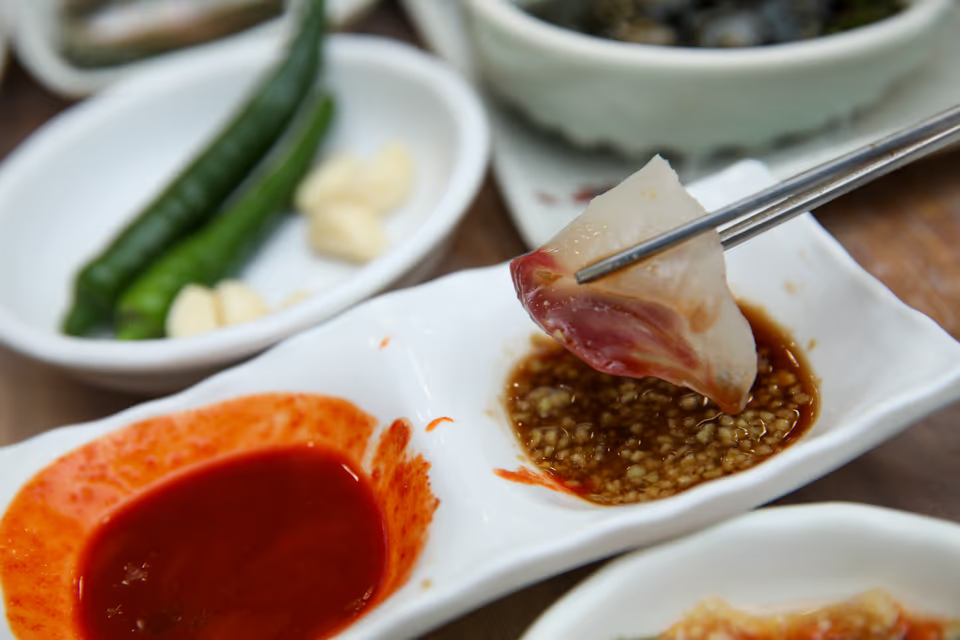
The biggest difference is whether the fish gets used alive and immediately, or caught and then rested for a stretch of time before it gets used. Korean hoe takes live fish lifted out of the tank, prepares it on the spot and cuts it thick; Japanese sashimi takes bled fish, lets it rest in refrigeration for half a day to more than a full day, and cuts it thin. That makes the sensation of chewing them close to opposite. With Korean hoe a crisp springiness arrives first, while on the other side a softness that wraps around the tongue and a deep savory flavor arrive first. The sauces split too. Here, the fish gets wrapped in lettuce or perilla leaf with vinegared chili sauce, soybean paste, garlic and chili; there, a little wasabi goes into soy sauce and each piece gets a dip. The look of the table differs as well. A Busan sashimi table gets laid with close to ten small side dishes, while a Japanese plate of raw fish sits beside little more than shredded radish and a shiso leaf. At the Jagalchi Haean-ro restaurant, eight in ten evening guests dip the first piece in vinegared chili sauce, and the other two start by stirring wasabi into soy sauce. Rather than one being correct, it is a question of what state you want to eat the fish in, so trying both methods alternately on one plate is the fastest comparison there is.
Before You Order
- Chew the first piece with no sauce and the springiness particular to live fish comes through immediately
- Take the second piece with wasabi stirred into soy sauce and you have the comparison
- From the third piece on, move to vinegared chili sauce or a wrap and the Busan table is complete
수정횟집
Why Korean hoe is cut thick and Japanese sashimi is cut thin
Jagalchi Haean-ro
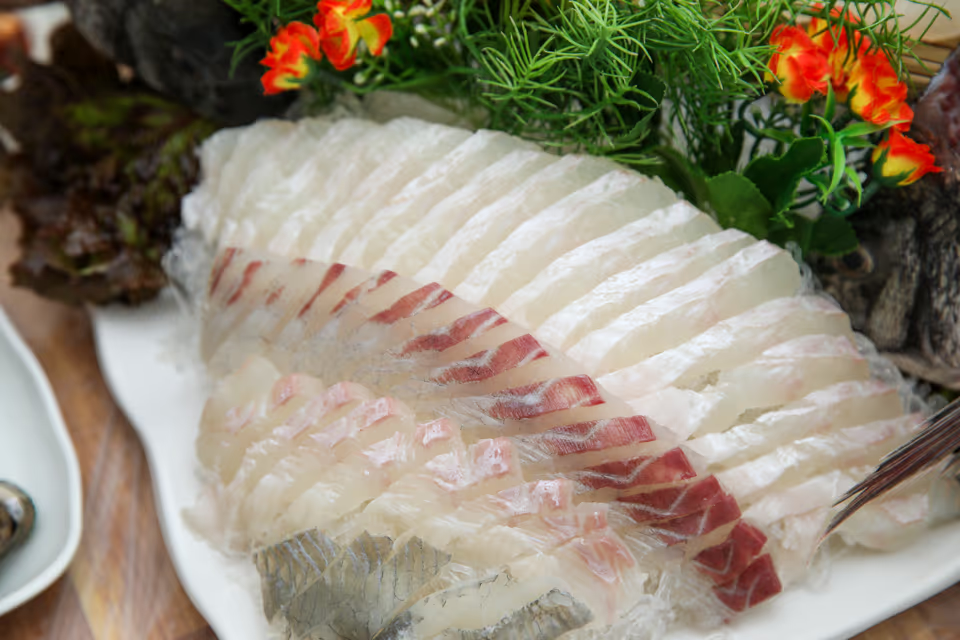
The condition of the fish decides the thickness. Live fish just prepared still has firm muscle, so cutting it thin makes the chew disappear, and it needs to be cut thick for the crisp springiness to come alive. Aged flesh works the other way: the muscle has relaxed into softness, so cutting it thick turns it mushy, and it needs to be cut thin for the savory flavor against the tongue to read clearly. So the difference in thickness is not a matter of taste, it is the result of how the fish was handled. The common thickness at a Korean sashimi restaurant is about that of a chopstick, and the Japanese side is roughly half of that. The resting time differs greatly as well. At a Busan sashimi restaurant, getting the live fish a guest picked onto the table within 10 minutes is the baseline, while in Japan the fish sits in refrigeration anywhere from half a day to several days depending on species, drawing the savory depth out from inside the flesh. White-flesh fish like flounder, rockfish and sea bream have their best springiness in the live state, while red-flesh fish such as tuna only improve with aging, so the species each country favors naturally split as well. That is also the reason the restaurant veteran with over a decade at Jagalchi cuts white-flesh fish thick. We will cut thinner for a guest who asks, but the first plate is worth trying at the standard thickness.
Before You Order
- Thick white flesh means live and thin red flesh means aged, and that reading is right most of the time
- Cutting live fish thin kills the springiness, so try the first plate at the standard thickness
- We adjust the thickness if you ask when ordering, but live fish tastes best at the standard cut
수정횟집
What changes between eating hoe with chili sauce in a wrap and eating it with soy sauce and wasabi
Jagalchi Haean-ro
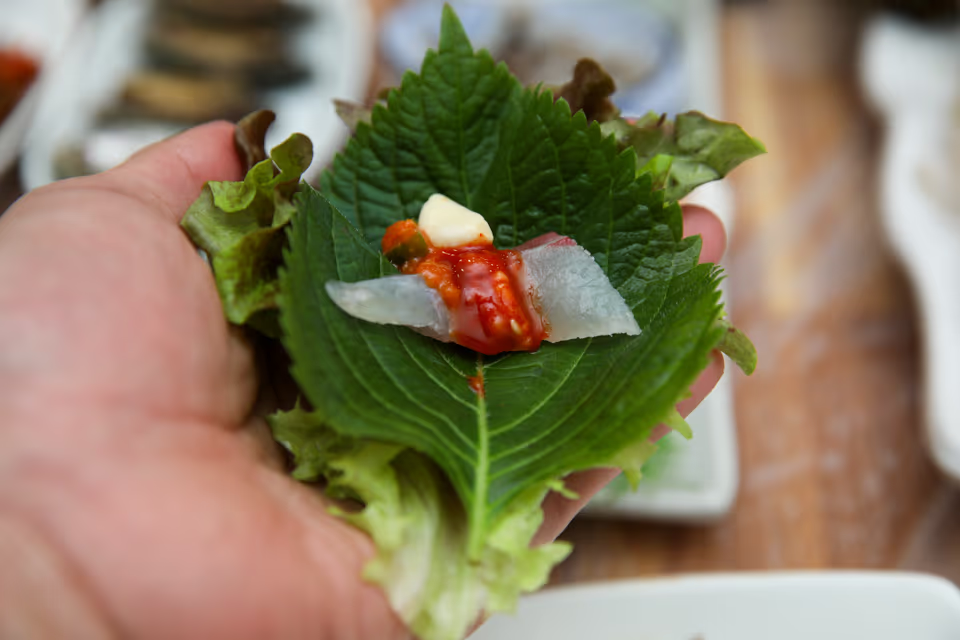
Vinegared chili sauce in a wrap is a method that lays aroma and heat on top of the springiness, while soy sauce and wasabi is a method that gently supports the natural savory flavor of the fish. The Busan way puts one piece of white-flesh fish on a leaf of lettuce or perilla with a little chili sauce, adds a clove of garlic or a slice of chili, and goes in as one mouthful. Thick live fish takes a long time to chew, so the garlic aroma and the sourness of the sauce fold in during that stretch. Japanese raw fish has thin, soft flesh, and laying strong seasoning on it buries the taste of the fish, so a few drops of soy sauce with only a trace of wasabi is the measure. That is why the same flounder leads with aroma when eaten in a wrap and leads with sweetness when eaten with soy sauce. The table at the Jagalchi Haean-ro restaurant comes with vinegared chili sauce, soy sauce, soybean paste and wasabi as standard, and most guests move through them in order, the first two or three pieces with chili sauce, soy sauce in the middle, soybean paste at the end. There is no reason to insist on only one. White flesh generally suits the wrap and fattier flesh suits soy sauce, and adding raw garlic to that turns it into a soju dish while leaving it out makes it a side dish for rice.
Before You Order
- One leaf of lettuce, one piece of fish, a little chili sauce and one clove of garlic is the Busan ratio
- Dip only the edge of the fish in soy sauce so the natural sweetness survives
- Laying a little wasabi on the fish keeps the aroma better than stirring it into the soy sauce
수정횟집
Why a Korean sashimi restaurant brings many side dishes and a Japanese plate brings few
Jagalchi Haean-ro
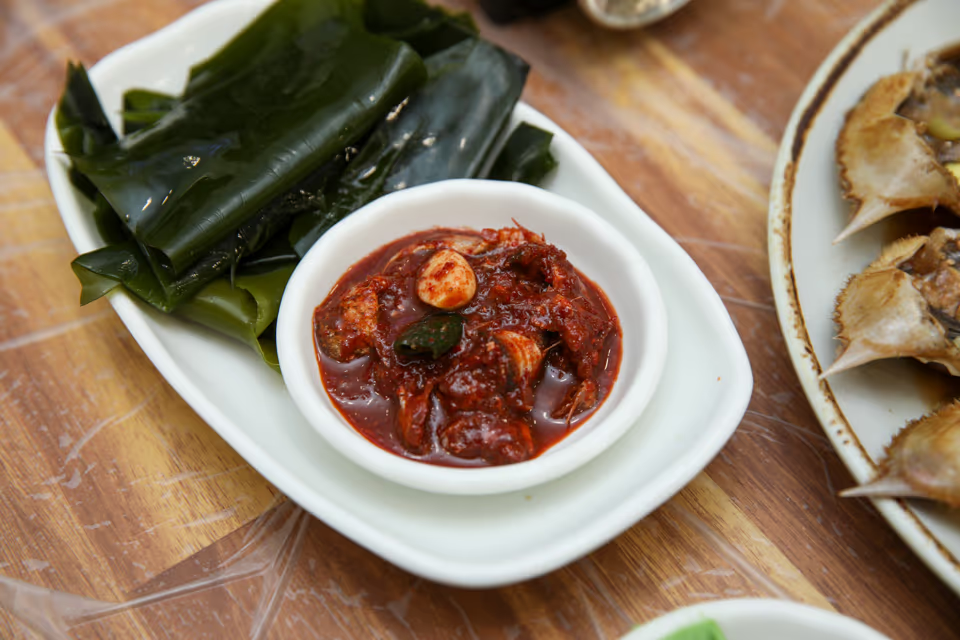
Korean sashimi restaurants bring many side dishes because raw fish is treated as an occasion eaten slowly alongside drinks, and Japanese accompaniments are few because raw fish is treated as one plate within a course. A Busan table gets laid first with small dishes of raw seaweed, salted seafood, pickled radish, cabbage salad, bean sprouts and seasoned greens, and the sashimi plate goes on top of that arrangement. When your palate gets heavy partway through the fish, you dip raw seaweed in salted seafood to rinse and go back to the sashimi, which makes the side dishes not decoration but a device for making the fish last. Our side dishes rotate daily based on what is fresh. A Japanese plate of raw fish gets shredded radish, a shiso leaf and some pickled ginger. The palate-rinsing role is the same but the variety is smaller and so is the quantity. In exchange, the flow brings grilled dishes or soup separately after the raw fish, so there is no need to put everything on one plate. Weekend evenings at 7 PM are the busiest at the Jagalchi Haean-ro restaurant, and at that hour the small side dishes often empty before the sashimi plate does. Plenty of side dishes does not mean a smaller portion of fish; read it instead as a setup for eating one plate of sashimi over two hours.
Before You Order
- Dip raw seaweed lightly in salted seafood to rinse and the next piece of fish tastes good again
- Just say the word and we refill any side dish that has emptied
- A table full of side dishes does not reduce the fish, the platter still comes at its listed size
수정횟집
Why a Korean sashimi meal ends with spicy stew and a Japanese one ends with rice or soup
Jagalchi Haean-ro
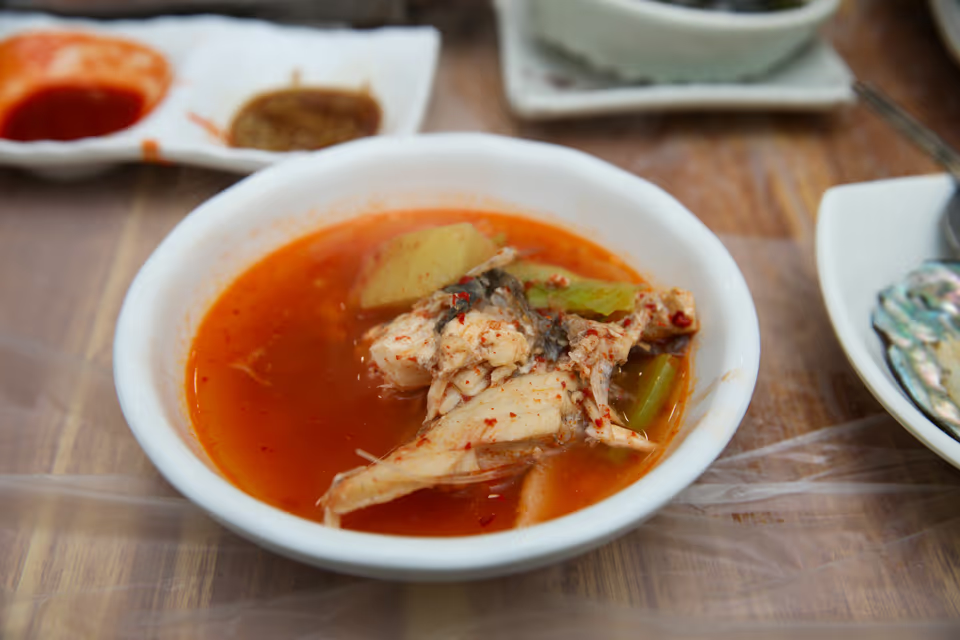
A Korean sashimi occasion ends with rice stirred into a spicy stew simmered from the bones and head left after the fish was cut, while Japanese raw fish sits at the front of a course so rice, miso soup and grilled dishes follow separately behind it. At a Busan sashimi restaurant the spicy stew is the back half of the raw fish. Call for a small rockfish spicy stew at KRW 50,000 (about USD 36) when about half the sashimi is left and the pot arrives as the fish is finishing, and ladling broth and flesh into your side bowl to stir with rice turns a drinking session into a meal. The structure has hot, bracing broth entering a mouth that has eaten cold raw fish for two hours, and the occasion settles with it. In Japan a hot dish follows the raw fish in the same way, but a clear soup or grilled fish follows rather than a bracing spicy stew, and the seasoning is milder. That is why someone used to Japanese raw fish, receiving a Busan table for the first time, finds the spicy stew being the dish after the sashimi the most unfamiliar part. At the Jagalchi Haean-ro restaurant, eight in ten sashimi tables close with the rockfish stew and the rest carry on with charcoal-grilled hagfish as a drinking dish. Deciding the close in advance also makes the sashimi size easy to settle. If you are calling for the stew, one size down is plenty.
Before You Order
- Call for the stew when half the sashimi is left and the pot arrives as the fish finishes
- If you plan to stir rice into the stew, one size smaller on the sashimi still leaves nothing over
- If broth feels like too much, carry on with a small charcoal hagfish at KRW 60,000 instead
수정횟집
How to order so you can compare both countries on one plate at a Jagalchi restaurant
Jagalchi Station Exit 2, 220m
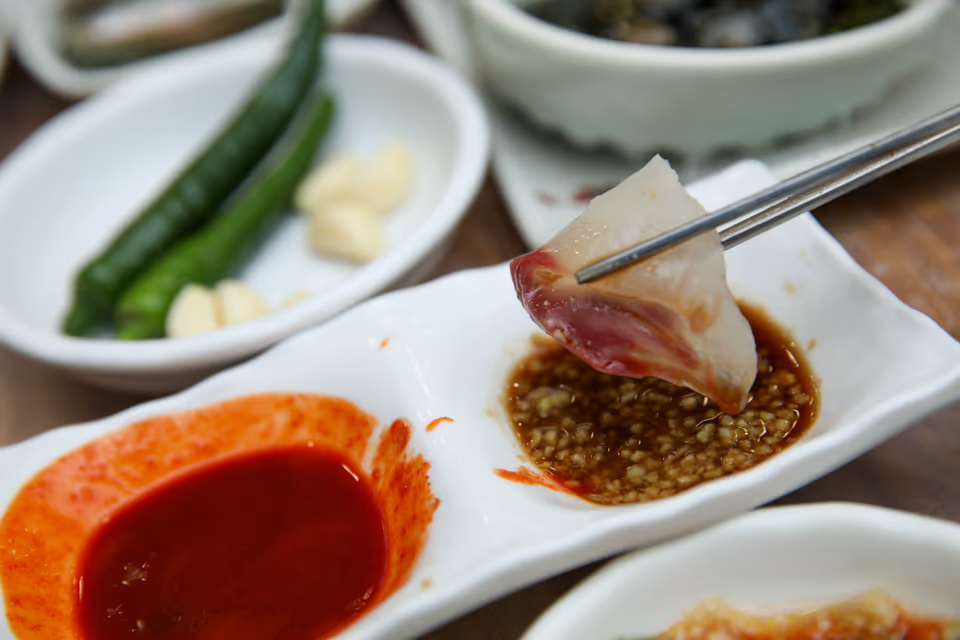
Putting soy sauce with wasabi and vinegared chili sauce with wrapping leaves on one small assorted platter at KRW 60,000 and alternating piece by piece is the easiest comparison method there is. We serve white-flesh live fish at the standard thickness, and saying cut a few pieces thin when you order gets half of it cut thin so you can taste both thicknesses together. Pricing is fixed by size with small for two, medium at KRW 80,000 for three, large at KRW 100,000 for four and extra large at KRW 120,000 for five or six, and for an anniversary, premium wild-caught sashimi from KRW 80,000 (about USD 58) goes out at the day-selected species price, built from species like spotted halibut or roughscale sole. The location is 220m from Jagalchi Station (Line 1) Exit 2 toward Jagalchi Haean-ro, about a 3-minute walk. It is two stops from Busan Station on Line 1, so you can be seated 20 minutes after stepping off the KTX, and a taxi runs about 10 minutes and KRW 6,000 to 8,000 from Busan Station, or 20 minutes and KRW 12,000 to 15,000 from Seomyeon. With 190 seats across the first and second floors it takes group dinners, and calling +82-10-8998-4803 ahead for four or more holds both the size and the seat. Afterward, the Jagalchi main hall is a 3-minute walk, BIFF Square 5 minutes and Yeongdo Bridge 7 minutes, which makes it easy to continue on foot. The Yeongdo Bridge deck lifts on Saturdays at 2 PM.
Before You Order
- Ask for one dish each of chili sauce and soy sauce and try the pieces alternately
- Saying cut a few pieces thin lets you compare both thicknesses on one plate
- For four or more on a weekend evening, calling +82-10-8998-4803 first is the safe move
| Item | Price | Notes |
|---|---|---|
| Assorted Platter, Small | KRW 60,000 | About USD 43 · for 2, fixed-size pricing |
| Assorted Platter, Medium | KRW 80,000 | About USD 58 · for 3 |
| Assorted Platter, Large | KRW 100,000 | About USD 72 · for 4 |
| Premium Wild-Caught Sashimi | From KRW 80,000 | Day-selected species price, spotted halibut or roughscale sole |
| Rockfish Spicy Stew, Small | KRW 50,000 | About USD 36 · the close, for 2 to 4 |
| Sashimi Set Meal | KRW 20,000 | About USD 14 · single tray, for comparing on your own |
Korean and Japanese Sashimi FAQ
Nearby Attractions
Jagalchi Market main hall
3-minute walkLive and fresh fish wholesale, a short walk after the meal
BIFF Square
5-minute walkSsiat-hotteok and other snacks after the meal
Yeongdo Bridge
7-minute walkDeck lifts Saturdays at 2 PM, a walk by the water
Gukje Market
8-minute walkTraditional market food and shopping
Before You Order
- Chew the first piece with no sauce to feel the springiness of live fish
- Ask for one dish each of chili sauce and soy sauce to compare both methods
- Saying cut a few pieces thin puts both thicknesses on one plate
- Call for the stew when half the sashimi is left, not at the end
- 220m from Jagalchi Station Exit 2 toward the coastal road, about a 3-minute walk
Suggested Evening Course
An Evening Tasting Two Countries From One Platter
- Arrive on Jagalchi Haean-ro, order a small platter and ask for a few thin cuts
- First piece with no sauce, second with soy sauce and wasabi
- Move to a wrap with chili sauce and garlic, rinsing with raw seaweed
- Half the plate gone, call for a small rockfish spicy stew
- Stir rice into the stew, then walk to Yeongdo Bridge
What to Eat Where
Jagalchi Haean-ro (the comparison plate)
- Assorted sashimi platter
- Premium wild-caught sashimi
- Rockfish spicy stew
- Sashimi set meal
Jagalchi Market main hall (live and fresh fish)
- Live fish browsing
- Fresh fish stalls
- 2nd-floor food court
Nampo-dong and BIFF Square (after the meal)
- Ssiat-hotteok
- Cafes
- Gwangbok-ro shopping
On Jagalchi Haean-ro, a Jagalchi ajimae with over 10 years of experience cuts white-flesh live fish at the thickness it needs
Assorted platter from KRW 60,000 · Premium wild-caught from KRW 80,000 · Both sauce sets standard, 220m from Jagalchi Station Exit 2
Read the full guide