How to Pick Live Fish from a Restaurant Tank, 5 Signs of Freshness
Swimming posture, fins, eyes, water clarity and density, a check that takes 30 seconds at the tank
The Short Answer
Live fish condition in a restaurant tank comes down to five signs: swimming posture, fins, eyes, water clarity and density. A fish holding level in the middle layer with intact fin edges is good, and clear water with no packed compartment means a managed tank. At a restaurant 220m from Jagalchi Station Exit 2, the assorted platter runs from KRW 60,000 small under fixed-size pricing.
수정횟집
What to look at first in a restaurant live fish tank
Jagalchi Haean-ro
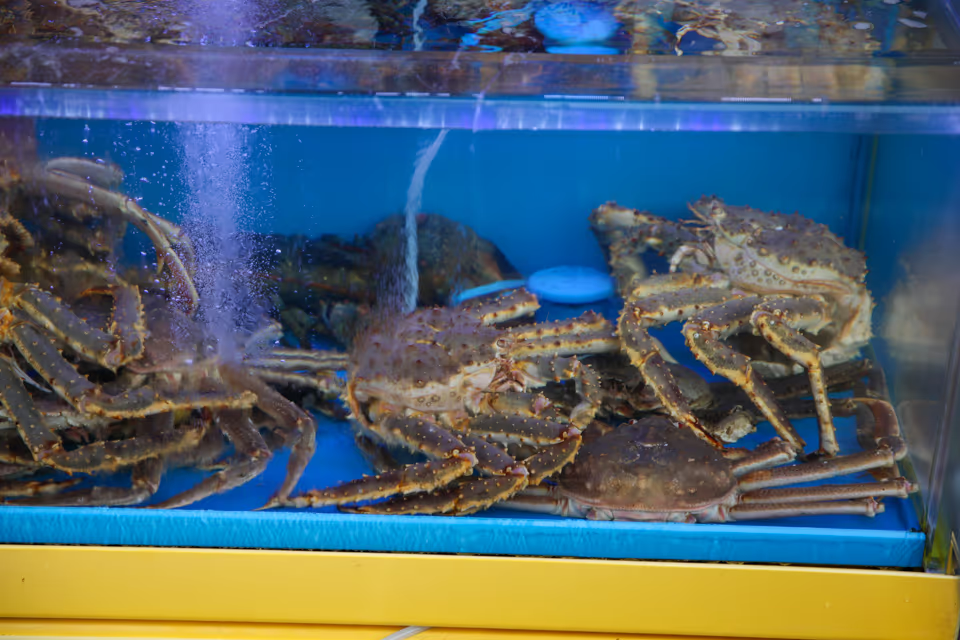
The first thing to look at is swimming posture. A live fish in good condition holds its body level in the middle layer of the water, moving its tail and pectoral fins slowly to keep position. The opposite signs are a fish lying belly-down on the bottom, a body tilted to one side leaning against the glass, or one floating near the surface with only its mouth working, all of which mean it is exhausted or short on oxygen. Fins are the second measure. A dorsal fin standing upright and a tail fin with an unfrayed edge mean the fish has not been in the tank long, while a frayed edge or a white rim means it has been held a while and rubbed against the walls. Flounder and other bottom-dwelling species lie flat normally, so this rule cannot be applied to them directly. Instead, look at whether the edge of the body ripples and whether it reacts to a human shadow. Rockfish normally hold position in mid-water with the head angled slightly up, and sea bream tend to circle in the same direction as a group. Normal posture differs by species, so comparing against other fish in the same compartment is the fastest read. The tank out front here also holds snow crab and king crab, and for those the equivalent check is whether the leg joints move on their own and whether they lift their claws. That is also why the restaurant's Jagalchi veteran, with over a decade on the job, reaches first for the fish that darts away when the net goes in. The strength left to escape is what makes the flesh firm once it is sliced. Eight out of ten evening guests walk straight past the tank, but spending 30 seconds on these two checks lets you judge for yourself what condition the sashimi on your table will be in.
What to Check at the Tank
- A fish holding level in the middle layer of the water is in the best condition
- A frayed tail fin edge is the signal that it has been in the tank a long time
- Flounder lying flat is normal, look at the body edge movement and the reaction instead
수정횟집
What the eyes and the water clarity in a tank tell you
Jagalchi Haean-ro
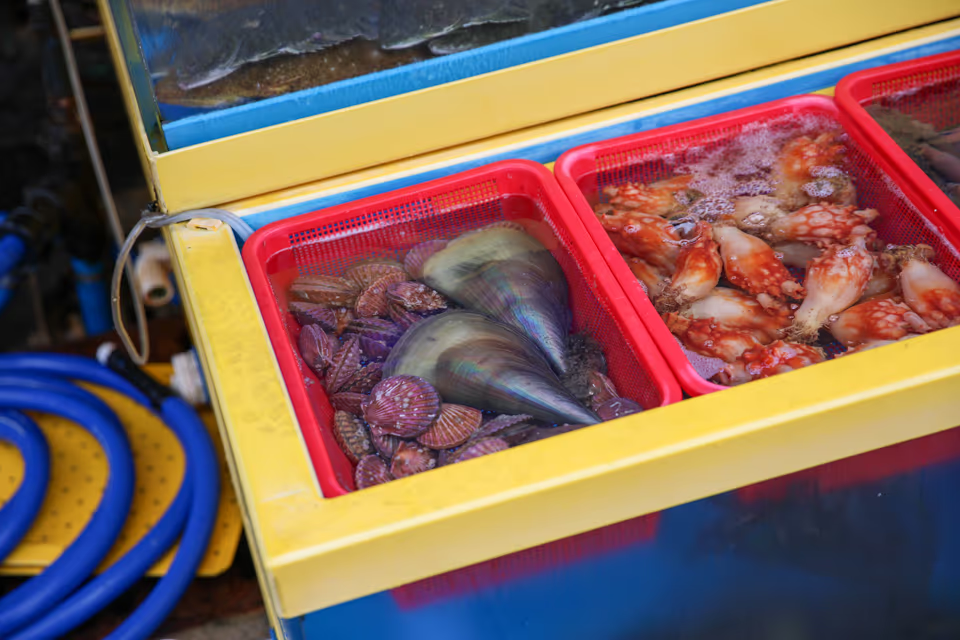
The eyes should be clear and bulging outward, and the water should be transparent enough to see the bottom. If a live fish has cloudy eyes or eyes sunk inward, it has already weakened in the water, and the flesh will be soft even when sliced. Water that looks yellow or holds foam for a long time is a signal that waste and leftover feed have built up, while a tank with a working filter and oxygen supply has clear water and no sediment on the bottom. Looking at whether several blue oxygen hoses run into the side of the tank out front and whether the stream keeps falling reveals the state of the upkeep immediately. Shellfish, sea pineapple and conch held in baskets need to be in a compartment where the water keeps circulating, and anything sitting in a still container will be slow to react when you tap the shell. A scallop with a slightly open shell should close the moment you touch it, and sea pineapple should have a firm shell with clearly defined bumps. A conch should have its operculum shut tight inward, and if the lid sits loosely open when touched, it has already lost its strength. Water temperature can also be judged by eye to a degree. If the tank glass has condensation and feels cool to the touch, the chiller is running. Live fish sitting in lukewarm water on a summer afternoon will struggle to last until evening. Even with clear water, a fishy smell means the filter is running behind, so taking one breath close to the tank is also a method. Only the salty smell of seawater, rather than a fishy one, is normal. Weekend dinner at 7 PM is the busiest hour, and a tank that keeps its water clear even at that time is a place with fast turnover and real upkeep.
What to Check at the Tank
- Avoid any fish with cloudy or sunken eyes, it has already weakened
- Oxygen hoses beside the tank and a falling stream are the first evidence of upkeep
- A scallop should close the moment you touch it, sea pineapple should have clear bumps
수정횟집
Why too many fish packed into one tank compartment is a bad sign
Jagalchi Haean-ro
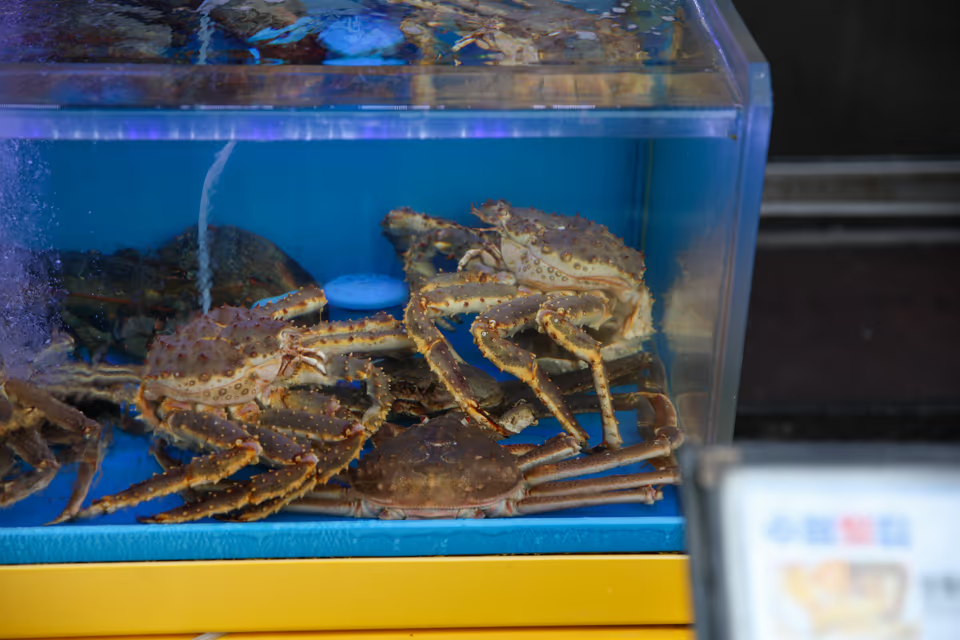
A compartment packed so tight that the fish have no room to turn is not a good sign. Density shows how much stress the live fish are under. Even in tanks of the same size, a compartment where five or six flounder move with room to spare and one where more than ten lie overlapping will diverge in condition after a single day. A packed compartment runs short on oxygen so the fish rise toward the surface, and they lose scales and damage their fins by knocking into each other. On the other hand, a tank that is too empty can mean few guests and slow turnover, so the best state is fish divided by species with each compartment holding some room. Long-legged crustaceans like snow crab and king crab are fine overlapping as long as their legs move on their own, but if several lie flipped over unable to right their legs, skip that compartment. A compartment with mixed species also warrants caution. Crowding species with different habits, like rockfish and flounder, into one compartment tires the weaker side first. Restaurants along Jagalchi Haean-ro generally divide compartments by species and attach the species name to each, and a name tag makes it easier for a guest to choose and easier for the restaurant to manage. Right after lunch, once turnover has run a cycle, a compartment can look empty, and at that point judge by the posture of the remaining fish rather than the emptiness itself. We divide the live fish that arrive in the morning into compartments by species, then check condition once more before the evening peak and pull out the weak ones. A compartment managed that way still swims the same way at 9 PM as it did in the morning. Simply counting the fish in a compartment tells a guest how often that restaurant cycles its tank.
What to Check at the Tank
- Compartments divided by species with name tags attached mean a place that manages its tank
- Skip a compartment where several crustaceans lie flipped and cannot right their legs
- Neither a packed compartment nor a completely empty one is a good sign
수정횟집
The difference between live fish and iced fish, and which one is better
Jagalchi Haean-ro
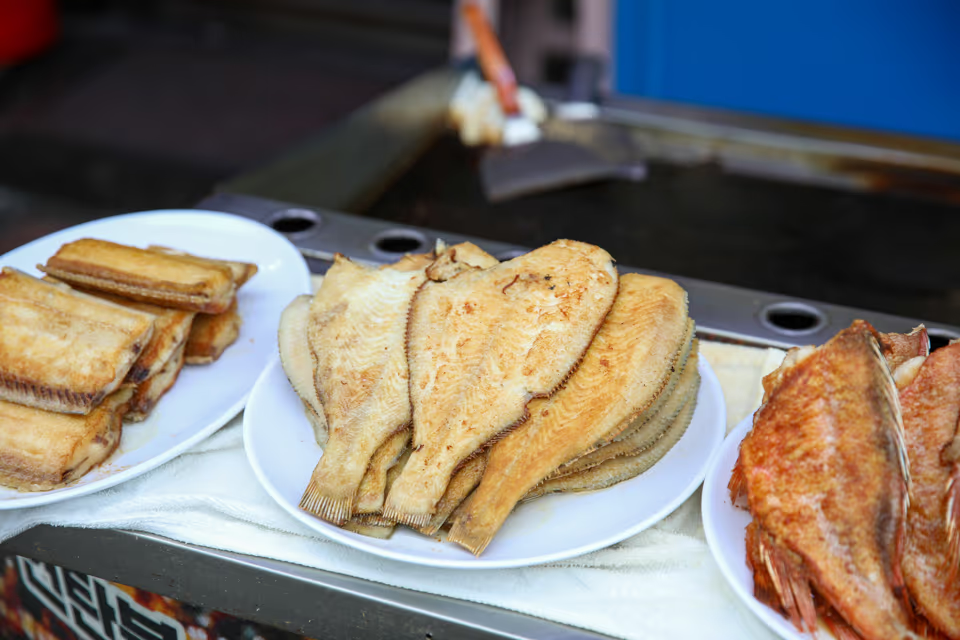
Live fish is prepared straight from a living state, while iced fish (seoneo) is packed on ice after the catch and aged for about a day. Rather than one being better, they serve different purposes. Live-fish sashimi has strong resilience when chewed with the sweetness arriving afterward, while iced fish has softer flesh with the savory depth arriving first. Busan locals insist on live fish specifically for sashimi, so restaurants along Jagalchi Haean-ro slice sashimi from tank fish and use iced fish for grilling and stews. That is why the front display holds rows of grilled flounder, red rockfish and plated cuts of grilled fish. Fish for grilling has no need to be alive, and in fact iced fish aged a day comes out moister when grilled. Judging iced fish works on different criteria than the tank. Clear eyes, bright red gills and resilience when pressed are good, while scales that come off easily or a soft belly mean it is old. If red liquid has pooled under a fish sitting on ice, that signals it has been packed a while, so check that too. Look at the tank for species you will eat as sashimi, and at the display case and the kitchen ice bin for species you will eat grilled or in a stew. The price differs too. For the same species, live fish carries the cost of tank upkeep and runs more expensive than iced, which is why grill and stew dishes come cheaper than sashimi. Eating sashimi and finishing with a spicy stew amounts to tasting both worlds at one table. Our grilled fish set at KRW 15,000 (about USD 11) and small rockfish stew at KRW 50,000 (about USD 36) come from the iced side, while the assorted platter comes from the tank. Plenty of guests believe only live fish is good, but knowing that stews and grilled dishes taste right only with iced fish makes choosing from the menu far easier.
What to Check at the Tank
- Sashimi calls for tank live fish, grill and stew taste right with iced fish
- Judge iced fish by bright red gills and resilience when pressed
- A tidy row of grilled plates on the display means the iced side is managed too
수정횟집
What to ask when picking live fish at the tank
Jagalchi Haean-ro
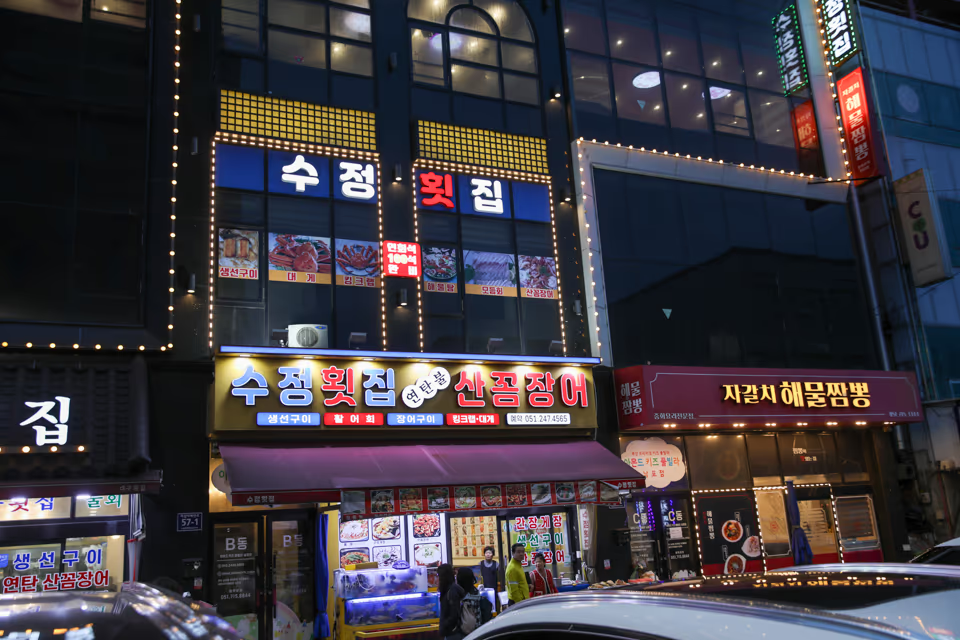
At the tank, three questions are enough. When this species came in today, whether it is wild or farmed, and how many servings one fish yields. A restaurant that answers the arrival time right away is one that manages its stock, and if the answer comes with hesitation, skipping that compartment is the safe call. Whether it is wild ties directly to the price. Premium wild sashimi runs from KRW 80,000 (about USD 58) under Daily Selection Pricing, built from whichever species had the best yield that day, such as striped flounder or parrotfish, while the assorted platter built around farmed flounder and rockfish runs from KRW 60,000 (about USD 43) small under fixed-size pricing. The servings question is how you match the size to your headcount. In the evening, when the sign on the restaurant front lights up, the ground-floor tank and the entrance show up brightly, and standing at the tank then and pointing at a species gets you the compartment in the best condition that day from the restaurant's Jagalchi veteran with over a decade on the job. Worth adding to the list: whether there is a separate fish used for the stew, whether they will make a stew from the bones left after slicing, and what the side dishes are. Side dishes rotate daily based on what is fresh. There is one trick to asking. If you do not know the species name, pointing with your hand and asking what it is works perfectly well. For species that get confused, like flounder and olive flounder, staff will separate them for you by eye position and mouth shape, so you can learn it right there. Plenty of guests hesitate to ask, but in Jagalchi, handing a better fish to the guest who asks is a long-standing custom. For four or more on a weekend evening, calling +82-10-8998-4803 ahead cuts out even the time spent deliberating at the tank.
What to Check at the Tank
- When it came in, whether it is wild, how many servings, those three questions are enough
- A restaurant that answers right away is one managing its arrivals
- Pointing at a species with your hand gets you the day's good compartment
수정횟집
How to confirm fixed-size pricing at the tank, and how to get here
Jagalchi Station Exit 2, 220m
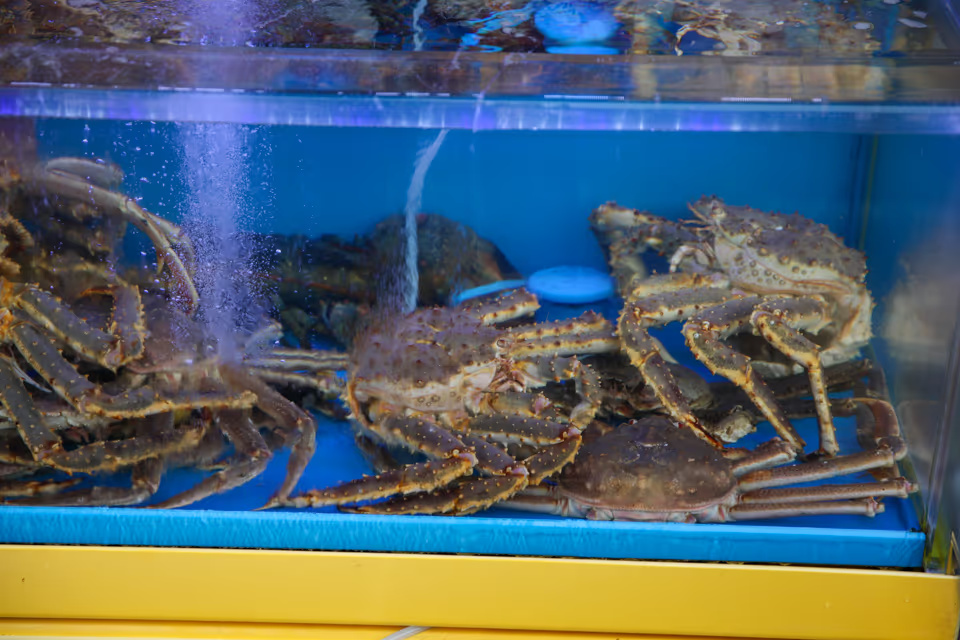
Fixed-size pricing is confirmed by whether small, medium, large and extra-large prices are written as numbers beside the tank or on the menu. Our assorted platter runs KRW 60,000 small, KRW 80,000 medium, KRW 100,000 large and KRW 120,000 extra-large, and those numbers do not change even when the day's species changes. An approach where no price is posted and they offer to weigh it and tell you means you cannot know the amount until the bill, so ask in advance. Premium wild sashimi is the one exception, running from KRW 80,000 under Daily Selection Pricing, and even then the standard is whether they tell you the day's composition and the amount before you order. The order of checks is simple. Look at the species condition in the tank, read the size prices on the menu, state your headcount to match the size, then sit down. Two people take small, three medium, four large, and five to six extra-large, while the sashimi set meal at KRW 20,000 (about USD 14) is a single-person plate. At payment, all you need to check is that the size you ordered matches the amount on the receipt, and any stew or grilled dish added on gets its own line. Cards and cash both work, and groups can split the bill. The restaurant sits 220m from Jagalchi Station (Line 1) Exit 2 toward Jagalchi Haean-ro, about a 3-minute walk. It is two stops from Busan Station on Line 1, so you can be standing at the tank within 20 minutes of stepping off the KTX. Seating across the first and second floors totals 190, making group dinners possible, and nearby are the Jagalchi main hall at a 3-minute walk, BIFF Square 5 minutes, Gukje Market 8 minutes and Yeongdo Bridge 7 minutes. Yeongdo Bridge opens on Saturdays at 2 PM, so walking over after lunch lines up well. A taxi runs about 10 minutes and KRW 6,000 to 8,000 (about USD 4 to 6) from Busan Station, or 20 minutes and KRW 12,000 to 15,000 (about USD 9 to 11) from Seomyeon.
What to Check at the Tank
- If small, medium, large and extra-large prices are written as numbers, it is fixed-size pricing
- For wild fish, hear the day's composition and amount before deciding
- 220m from Jagalchi Station Exit 2 toward the coastal road, about a 3-minute walk
| Item | Price | Notes |
|---|---|---|
| Assorted Platter, Small | KRW 60,000 | About USD 43 · for 2, tank live fish, fixed-size pricing |
| Assorted Platter, Medium | KRW 80,000 | About USD 58 · for 3 |
| Assorted Platter, Large | KRW 100,000 | About USD 72 · for 4 |
| Premium Wild Sashimi | from KRW 80,000 | About USD 58 · Daily Selection Pricing, striped flounder and parrotfish among others |
| Grilled Fish Set | KRW 15,000 | About USD 11 · iced fish grilled, per person |
| Rockfish Stew, Small | KRW 50,000 | About USD 36 · iced fish stew, enough for four to share |
Picking Live Fish FAQ
Nearby Attractions
Jagalchi Market main hall
3-minute walkLive and fresh fish wholesale, a practice round for reading tanks
BIFF Square
5-minute walkSsiat-hotteok and other snacks after the meal
Gukje Market
8-minute walkTraditional market food and shopping
Yeongdo Bridge
7-minute walkOpens Saturdays at 2 PM, a walk after lunch
What to Check at the Tank
- Thirty seconds at the tank, start with swimming posture and fins before you go in
- Pick the species from a compartment with clear water and a running oxygen hose
- Ask when it came in, whether it is wild, and how many servings it yields
- Confirm fixed-size pricing by whether small through extra-large prices are written as numbers
- 220m from Jagalchi Station Exit 2 toward the coastal road, about a 3-minute walk
Suggested Half-Day Course
A Jagalchi Half-Day for Training Your Eye on Tanks
- Browse the live fish compartments at the Jagalchi main hall, get an eye for posture by species
- Arrive on Jagalchi Haean-ro, run the five checks on the tank out front
- Set an assorted platter size to your headcount, confirm the day's composition for wild fish
- Compare live fish and iced fish through the rockfish stew
- A walk to Yeongdo Bridge, catch the 2 PM opening on Saturdays
What to Eat Where
Jagalchi Haean-ro (tank live fish restaurants)
- Assorted platter small to extra-large
- Premium wild sashimi
- Sashimi set meal
Jagalchi Market main hall (live and iced fish)
- Live fish compartments
- Iced fish stalls
- 2nd-floor food court
Restaurant front display (iced fish grilled)
- Grilled fish set
- Rockfish stew
- Cod stew
On Jagalchi Haean-ro, a Jagalchi ajimae with over 10 years of experience nets your fish from the tank herself
Tank live fish assorted platter by fixed size · Premium wild sashimi · Iced fish grill and stew, 220m from Jagalchi Station Exit 2
Read the full guide